
 By
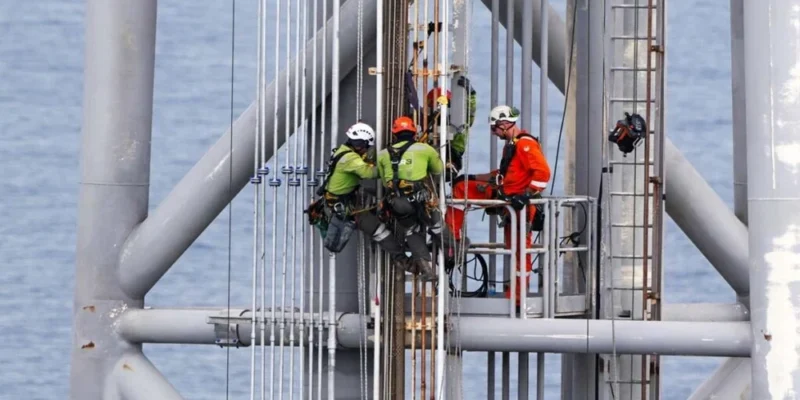
When a defect appears twenty storeys up, the first question most managing agents ask is how much scaffolding will cost. Often the better question is whether scaffolding is needed at all. For a crack, a failed sealant joint or a leaking window frame, erecting a full structure can cost more and take longer than the repair itself. Rope access repair work reaches the same defect with technicians suspended on ropes, and understanding how it is planned, priced and supervised helps owners decide when it is the right tool.
How the Method Works
Each technician works on two independent ropes: a working line that carries their weight and a backup line fitted with a fall-arrest device. Both are anchored to secure points on the roof, and the technician descends, ascends and moves sideways using mechanical devices rather than relying on grip. Because there are always two separate systems, a failure in one does not lead to a fall. The method is closer to industrial engineering than to climbing, and it is governed accordingly.
The Kinds of Defects It Handles
Rope access suits work that is localised or spread thinly across a large facade. Typical tasks include sealing cracks, renewing sealant around windows and cladding joints, patching spalled concrete, injecting leaks, replacing small facade elements, cleaning and inspecting. It is less suitable for heavy structural replacement that needs bulk materials stored at height or several trades working at the same spot for weeks.
Why Owners Choose It Over Scaffolding
The main advantages are speed, cost and disruption. Rigging a building for rope work takes hours rather than weeks. There is no structure blocking windows, balconies or walkways for months, which matters to residents and tenants. On tall or awkwardly shaped buildings, where gondolas cannot reach every elevation, ropes may be the only practical option. For a single leaking unit high on a tower, the savings can be considerable.
Inspection Before Repair
Good repair begins with accurate diagnosis. Technicians can work at close range, tapping concrete to detect hollow areas, photographing cracks against a scale and testing sealant adhesion by hand. For older buildings in Singapore that fall under the periodic facade inspection regime, which applies to buildings taller than 13 metres and more than 20 years old, close-range inspection by rope is a common way to gather the evidence a professional engineer needs to assess the facade.
Planning and Permits
Before work starts, the contractor should survey anchor points, prepare a method statement and risk assessment, and confirm the arrangements with the building management. Work at height in Singapore is regulated, and a fall prevention plan is expected for this kind of job. Owners should also agree how the area below will be cordoned off, because the main hazard to the public is a dropped tool or material rather than the technician. Clear agreement on these points at the start is what keeps rope access repair work running smoothly once technicians are on the facade.
Who Should Be on the Ropes
Competence matters more than in almost any other maintenance trade. Technicians are commonly certified under recognised rope access schemes with graded levels, and every team should include a supervisor of the highest grade who is responsible for rigging and rescue. Ask to see certification for each person, not only the company, and confirm that a rescue plan is in place so that an injured technician can be recovered without waiting for emergency services.
Weather and Scheduling
Wind, lightning and heavy rain stop rope work. Most method statements set a wind speed limit and require teams to descend when a storm approaches, which in Singapore can mean losing afternoons during the monsoon months. Sealants and coatings also need dry surfaces to bond. A realistic programme allows for these interruptions instead of promising a fixed finish date that the weather will not respect.
Pricing and What Drives It
Costs are usually driven by the number of drops needed to cover the defects, the height and shape of the building, the time spent rigging and the materials used. A few scattered defects on different elevations can cost more than one concentrated area, because each change of position requires re-rigging. Asking for a marked-up elevation showing every repair location makes quotations easier to compare and later easier to verify.
Verifying the Finished Work
Because the work is out of sight, documentation is essential. Ask for dated before and after photographs of each repair, cross-referenced to a facade drawing, and a short report describing what was found and what was done. For leaks, a water test after repair confirms the fix. This record also becomes valuable evidence for future inspections and for any warranty claim.
Deciding When to Use It
Consider rope access when defects are localised, when the building is tall or hard to reach, and when keeping residents’ views and access clear is important. Choose scaffolding or gondolas when work is heavy, continuous and concentrated. In either case, select a contractor on certification, safety planning and the quality of their reporting rather than price alone. Well managed, rope access repair work keeps high-rise maintenance fast, safe and affordable.



Comments